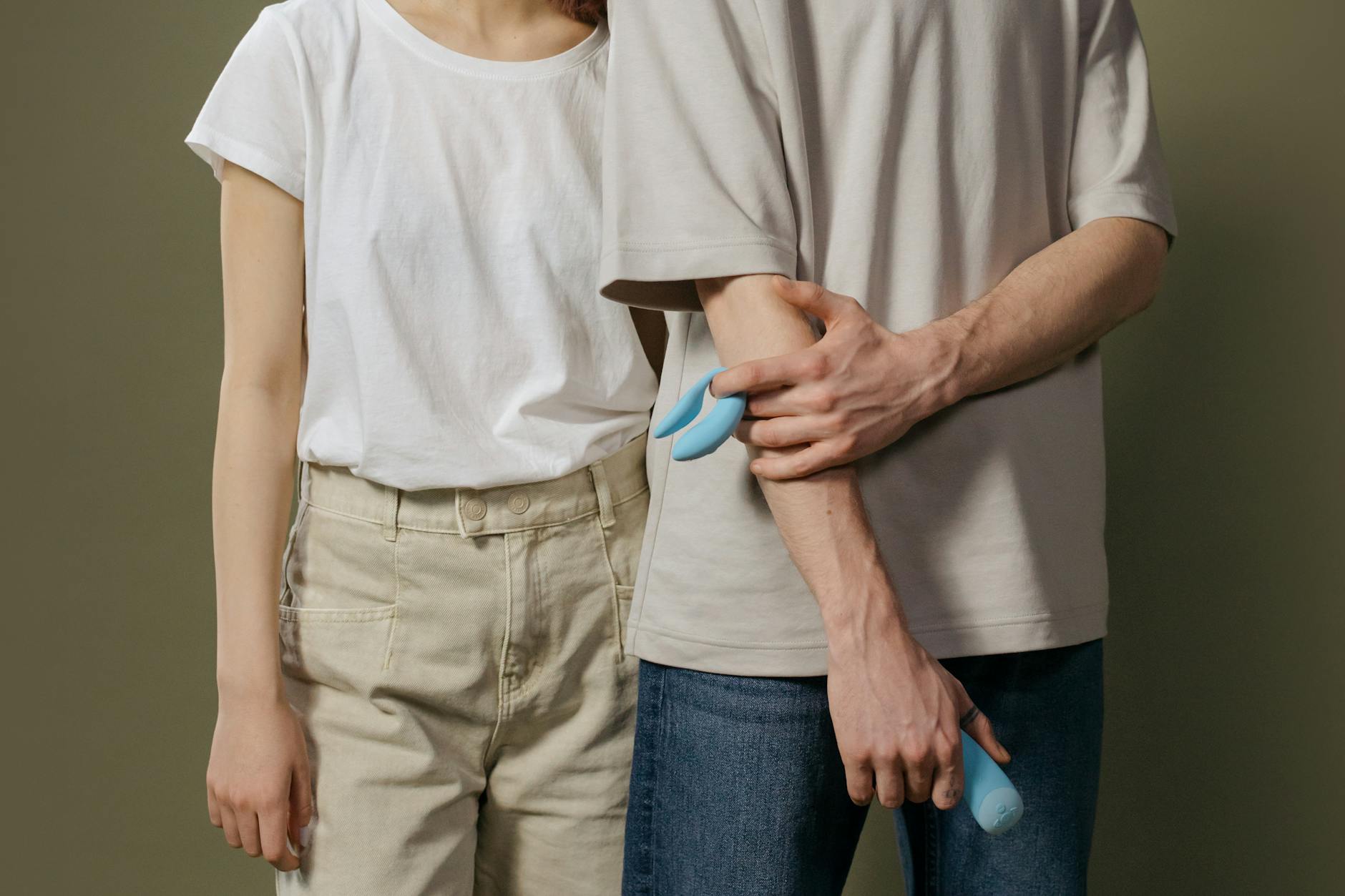
Here's what everyone's too awkward to ask
Yes. The sensation genuinely changes when someone's there. Not because the lemon vibrator itself works differently, but because you do. Your nervous system, your attention, your anticipation, your entire experience of pleasure shifts the moment another person enters the room.
This isn't mystical or psychosomatic. It's neurobiology and psychology meeting in real time, and understanding it transforms how couples approach pleasure together.
The nervous system shows up differently
When you're alone with a lemon clitoral vibrator, your body is in a specific state. Your pelvic floor has a certain baseline tension. Your breathing follows a particular rhythm. Your brain is organizing sensory data one way.
The second a partner is present, your autonomic nervous system recalibrates. There's activation that happens before anything physical changes. You might feel more alert, more self-conscious, or more aroused depending on the dynamic with your partner and how you feel about being watched.
This creates a fork in the road: threat response or arousal response. If being watched feels safe and desired, your body leans into heightened sensitivity. If it feels exposing or risky, you tense up. The same lemon vibrator, the same pattern setting, the same body. But the experience is objectively different because your nervous system is reading the environment differently.
What actually intensifies
Three things change reliably when a partner is watching:
Anticipation builds faster. Your brain is now processing two simultaneous streams of information: the physical sensation from the lemon vibrator and the emotional/social data from your partner's presence. This dual attention actually sharpens arousal in most cases. You're not just feeling pleasure. You're aware of being desired while experiencing pleasure. That's a compounding effect.
Orgasm often feels more pronounced. Clinical observation and partner feedback both show this. Orgasms with a partner present tend to be more intense or memorable, even if the physical mechanics are identical. This is partly psychological (you're being witnessed at your most vulnerable, which is a form of intimacy), and partly neurological (the brain's reward centers activate more fully when there's social validation happening alongside physical pleasure).
Recovery takes longer. After orgasm, your body needs to come down. When you're alone, that descent is private. With a partner watching, there's often an awkward moment of transition. Some people feel more self-conscious. Others feel closer. The physiological recovery is the same. The emotional context is completely different.
What does NOT change
Here's what matters just as much: the actual tissue sensitivity stays constant. The clitoral nerve endings don't suddenly become more or less responsive because someone's in the room. If pattern 3 on the lemon vibrator is your sweet spot when you're solo, pattern 3 will still be your sweet spot partnered.
What changes is tolerance and attention, not capacity. You might perceive the intensity differently because you're in a different mental state. You might reach orgasm faster or slower depending on comfort level. But the tool itself hasn't changed. The vibration frequency is identical. The sensation profile is identical. Your interpretation of it has shifted.
This distinction matters because it prevents people from thinking they need a different lemon clitoral vibrator when what they actually need is a different emotional environment with their partner.
The role of permission and vulnerability
I work with a lot of couples around this exact tension. What I've noticed is that the quality of the experience depends almost entirely on whether both people feel genuinely safe.
If you're using a lemon vibrator with a partner and you're thinking "I hope they think I look sexy" or "I hope they don't judge me," your nervous system is split. You're defending while you're also trying to be present. That creates a ceiling on pleasure that has nothing to do with the toy.
If you're partnered and you've negotiated that this is hot and wanted and that you're both invested in each other's pleasure, the same activity becomes significantly more satisfying. Not because the vibrator changed. Because you did.
Building comfort if this is new
If you and your partner are exploring partnered pleasure for the first time, here's what actually helps:
Start with communication outside the moment. Talk about what you're curious about, what makes you nervous, and what you'd like to happen or not happen. "I want you to watch but maybe not talk the first time" is a completely valid boundary. So is "I want you to touch me too." You're setting the terms.
Then slow the approach. You don't have to jump into full partnered play immediately. Some people like their partner present but focused on their own pleasure first. Others want gradual initiation. There's no speed that's "right" except the one where both of you feel okay.
For actual physical sensation, consider where you want to be positioned. Can you see your partner's face? Do you want to? Some people find eye contact during climax deeply intimate. Others find it too much. Neither is wrong. You're designing an experience that works for your nervous systems.
Last: remember that using a lemon clitoral vibrator partnered is not a performance. It's a shared experience. Your partner's job isn't to judge or critique. It's to be present and engaged with your pleasure. If they're not capable of that, that's a different conversation entirely, and it's worth having before introducing toys.
When sensation feels too intense with a partner
Sometimes the opposite happens. You can handle pattern 5 solo but with your partner there you need pattern 2. This usually means your nervous system is in slight protective mode, even if emotionally you're into it.
This is normal and fixable. Lower the intensity. Take more time building arousal beforehand. Let your partner touch you in other ways while you use the lemon vibrator. Create more continuity between the toy and their presence so it doesn't feel like a sudden switch in focus.
Or just acknowledge that you have different comfort zones in solo versus partnered contexts, and that's okay. Some people thrive on the intensity of being watched. Others need a softer entry point. Neither preference is a limitation.
The vulnerability piece that changes everything
I'm going to say something that sounds simple but lands differently once you've actually felt it: pleasure with a partner present is intimacy. Not because you're having sex together. But because you're letting someone see you at a moment of complete absorption in sensation.
That exposure does something neurologically. It activates your attachment systems. It signals to your brain that this person is safe enough to be vulnerable around. That's powerful. And yes, it changes how pleasure feels.
If you're working toward deeper connection with a partner, using a lemon vibrator together can be part of that conversation. It's not the same as other forms of partnered sex, and that's exactly why it can be so useful. It creates a specific kind of intimacy.